Best Open-Source Game Engines for Making an FPS
The best open source game engine for FPS projects: Godot, ioquake3, DarkPlaces, FTEQW, O3DE and Bevy, with licences, versions and the shooters built on them.
Published . Updated . 6 min read.

The best open source game engine for FPS projects in 2026 is Godot for most developers. It has an MIT licence, a full 3D editor that runs on Linux, and an FPS add-on in development. For a fast, retro arena shooter, consider a Quake-lineage engine such as ioquake3, DarkPlaces or FTEQW. O3DE is better suited to large, high-fidelity 3D projects with a team behind them, while Bevy is worth considering if you work with Rust.
This guide draws on the official websites and GitHub repositories of each project, the Cinevva open source engine guide and earlier research for the best open source FPS games. We did not build a game in each engine for this guide. Versions and GitHub star counts were checked on 12 November 2026.
Quick picks
- Best for most FPS projects: Godot
- Best for a Quake 3 style arena shooter: ioquake3
- Best for a Quake 1 style shooter with modern rendering: DarkPlaces
- Best multi-game Quake engine for modders: FTEQW
- Best for large, high-fidelity 3D: O3DE
- Best for Rust developers: Bevy
We may earn a commission if you buy through links on this page. It never changes our verdicts. How we review.
Godot 4 Game Development Projects by Chris Bradfield (paperback).
Check price on AmazonEngine-to-game table
| Engine | Licence | Language | Linux editor | Open source FPS built on it | Current version (checked 12 Nov 2026) |
|---|---|---|---|---|---|
| Godot | MIT | GDScript, C#, C++ via GDExtension | Yes, full editor | Liblast (in development) | 4.7.2 stable, 18 Aug 2026; 4.8 in beta |
| ioquake3 | GPL v2 | C (Quake III Arena code) | No editor; maps in TrenchBroom | Quake III Arena mods; OpenArena uses the same GPL id Tech 3 code | Rolling builds; code updated 4 Nov 2026 |
| DarkPlaces | GPL v2 | C, QuakeC | No editor; maps in TrenchBroom | Xonotic | Rolling builds; code updated 5 Nov 2026 |
| FTEQW | GPL v2 | C, QuakeC | No editor; maps in TrenchBroom | Runs Quake, QuakeWorld, Quake II, Quake III Arena and Hexen II | Rolling builds; code updated 2 Nov 2026 |
| O3DE | Apache 2.0 or MIT | C++ | Yes | None we could verify | 2605.0, 27 May 2026 |
| Bevy | MIT or Apache 2.0 | Rust | No editor; code first | None we could verify | 0.20.1, 28 Oct 2026 |
Sources: each project's site and GitHub repository (licence field and latest push), Godot and Bevy GitHub releases, the O3DE 2605.0 release, Xonotic's licence file and the OpenArena site. O3DE's own licence file offers Apache 2.0 or MIT. Cinevva lists Apache 2.0. Bevy ships both an MIT and an Apache 2.0 licence.
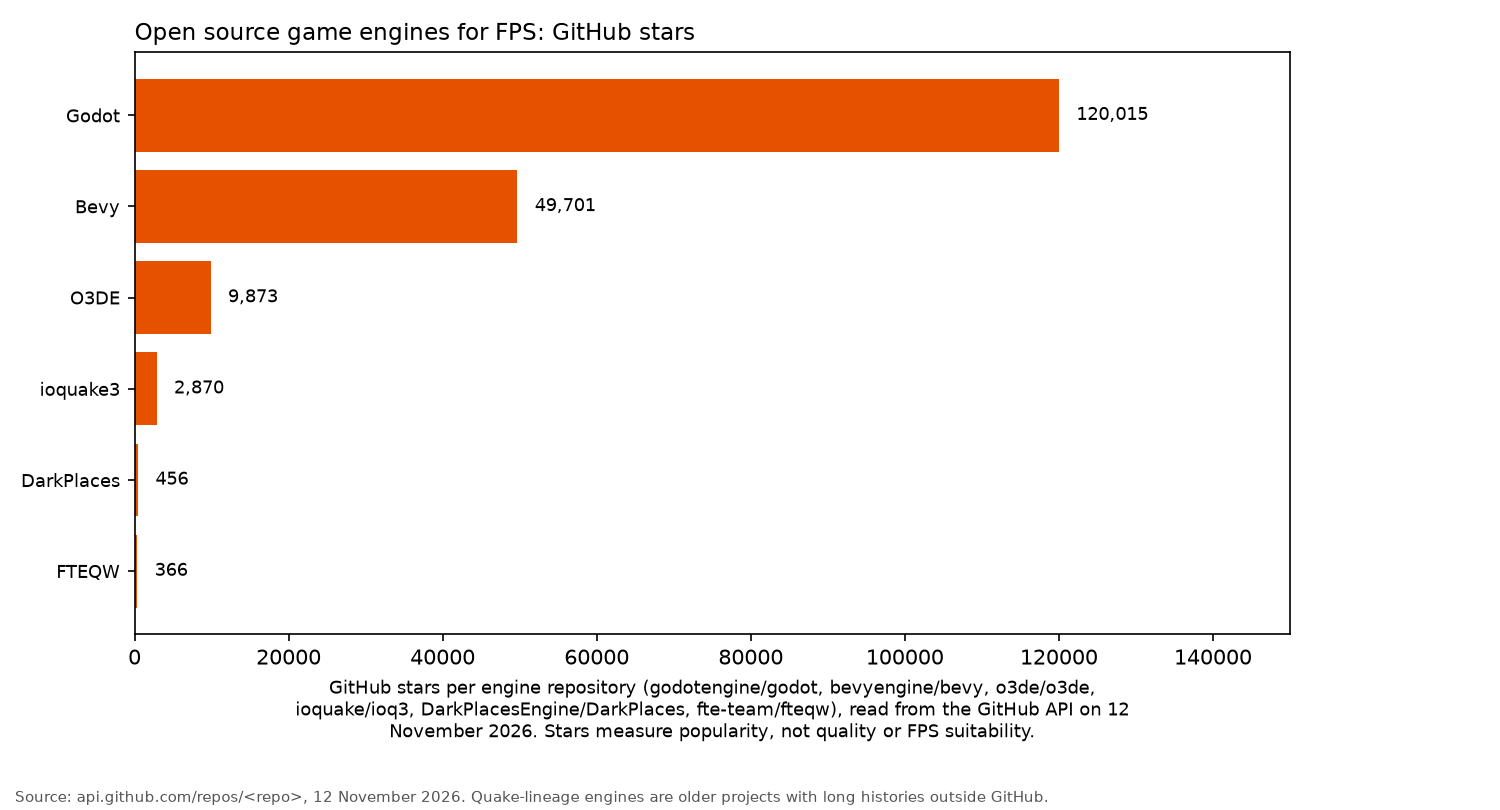
The chart shows GitHub stars for each engine repository on 12 November 2026. Stars measure popularity, not quality or how suitable an engine is for an FPS. Quake-lineage engines are older projects with long histories outside GitHub.
The engines
Godot: best for most FPS projects
Godot is MIT licensed, with no fees or revenue caps, per Cinevva. It supports both 2D and 3D development from a single editor. Its features page lists GDScript, C# and C++ through GDExtension, alongside built-in OpenXR support. Godot 4.7.2 is the latest stable release on GitHub (18 August 2026). Godot 4.8 is in beta: the download archive lists 4.8-beta3, dated 9 November 2026.
FPS developers may also want to look at Liblast Framework. This Godot 4 add-on is designed for online FPS games and is being developed for the open source shooter Liblast. Its own page makes clear that the documentation is still under construction and many features have yet to be implemented. The latest commit on the default branch is dated 13 June 2025.
Who it's for: solo developers and small teams starting a new 3D shooter. Who it isn't for: anyone looking for a complete FPS kit straight out of the box.
Godot 4 Game Development Projects by Chris Bradfield (paperback).
Check price on AmazonGame Development with Godot 4 and C# by Kati Baker (paperback).
Check price on Amazonioquake3: best for a Quake 3 style arena shooter
ioquake3 is the community-maintained engine for Quake III Arena. id Software released the original code under GPL v2 on 20 August 2005, as the project's website notes. The engine supports Quake 3, its mods and entirely new games.
The 7DFPS game jam runs from 4 to 13 December 2026. The ioquake3 website also encourages developers to build new projects on the engine.
Who it's for: fans of fast arena movement and modders. Who it isn't for: anyone looking for modern lighting without putting in substantial extra work.
DarkPlaces: best for Quake 1 style shooters
DarkPlaces takes the 1996 Quake engine as its starting point, adding modern rendering features and extending QuakeC, per its repository. Xonotic uses the engine, although the DarkPlaces team makes clear that it has no special relationship with the game. Linux x86_64 builds are available.
Who it's for: developers making retro-style shooters who want improved visuals. Who it isn't for: anyone starting from scratch without any Quake knowledge.
FTEQW: best multi-game Quake engine for modders
FTEQW supports Quake, QuakeWorld, Quake II, Quake III Arena and Hexen II. Its feature set includes split-screen multiplayer, voice chat, plugin support and servers for hundreds of players. According to its website, it runs on Windows, Linux and OpenBSD.
Who it's for: modders working across several Quake-era games. Who it isn't for: anyone whose project does not build on Quake-era content.
O3DE: best for large, high-fidelity 3D
O3DE is a Linux Foundation project focused on high-fidelity 3D, according to Cinevva and its own website. Release 2605.0 arrived on 27 May 2026. It is a heavyweight engine and does not have a browser target.
Who it's for: funded teams with AAA ambitions. Who it isn't for: solo hobby projects.
Bevy: best for Rust developers
Bevy is a data-driven game engine written in Rust, built around its own entity component system and released under either the MIT or Apache 2.0 licence. Version 0.20.1 arrived on 28 October 2026.
Cinevva notes that development moves quickly, with breaking changes between versions.
Who it's for: Rust programmers who are comfortable working in code. Who it isn't for: anyone who wants a visual editor.
Where to start
- Godot: install the editor and work through the official documentation. Then move on to a 3D development book, such as the cookbook below.
- Quake engines: create maps in TrenchBroom, the free Quake level editor, then load them into ioquake3, DarkPlaces or FTEQW.
- Play the classics first: browse the open source FPS games list and open source games hub. The Linux gaming guide is another useful starting point.
Godot 4 Game Development Cookbook by Jeff Johnson (paperback).
Check price on AmazonFor testing maps, see our gaming mouse for Linux and mechanical keyboard for FPS guides.
FAQ
Can Godot make an FPS?
Yes. Godot includes a full 3D engine and editor, and Liblast Framework is in development as a Godot 4 add-on for online FPS games.
What engine did Xonotic use?
DarkPlaces, an enhanced Quake 1 engine released under GPL v2.
Is Godot good for 3D?
For indie-scale 3D projects, yes. Cinevva describes it as the closest open source all-round replacement for a proprietary engine.
What is the best free engine for a shooter?
Godot is a good choice for a new 3D game. For a classic arena shooter feel, consider ioquake3 or DarkPlaces.
More from OpenFrag: History · Open source games · How we review