Best CPU for Linux Gaming (2026)
The best CPU for Linux gaming: Ryzen 7 9800X3D and 9850X3D, value 7800X3D, budget 9600X and 5600, plus Intel and a 16-core option, with a pairing table.
Published . Updated . 9 min read.
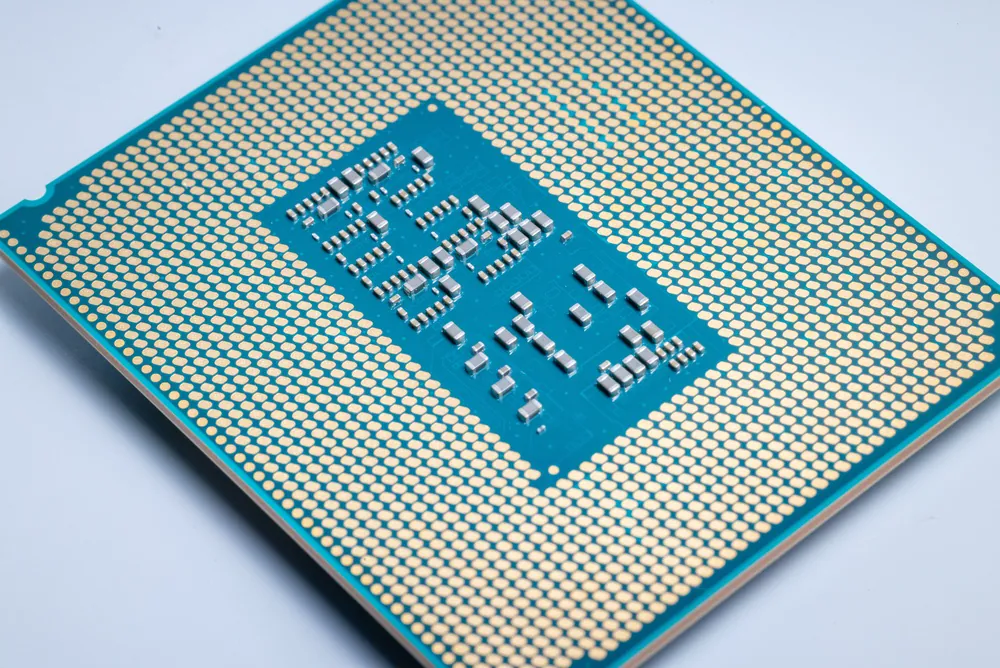
The best CPU for Linux gaming for most players is the AMD Ryzen 7 9800X3D. It has eight cores, 3D V-Cache, 104MB of total cache and solid support on current Linux kernels.
The Ryzen 7 9850X3D is slightly faster for a small premium, while the older Ryzen 7 7800X3D offers similar performance for less. On a tighter budget, the Ryzen 5 9600X covers AM5 builds and the Ryzen 5 5600 is the AM4 option. The pairing table below helps match each CPU with a graphics card, RAM and resolution.
Specs come from the UK Amazon listings, AMD's wording on those listings, and Phoronix, checked on 19 November 2026, plus published reviews that we credit by name. We have not benchmarked these processors ourselves. This guide brings published results together.
Jump to: Quick picks · Pairing table · Spec table · The CPUs · Linux notes · FAQ
We may earn a commission if you buy through links on this page. It never changes our verdicts. How we review.
Quick picks
- Best overall: AMD Ryzen 7 9800X3D (8 cores, 104MB cache, AM5)
- Fastest for gaming: AMD Ryzen 7 9850X3D (up to 5.6 GHz)
- Best value X3D: AMD Ryzen 7 7800X3D
- Budget AM5: AMD Ryzen 5 9600X (6 cores, 65 W)
- AM4 upgrade: AMD Ryzen 5 5600 (cooler included)
- Gaming plus heavy work: AMD Ryzen 9 9950X3D (16 cores)
- Intel option: Intel Core Ultra 7 265K (20 cores, LGA1851)
AMD Ryzen 7 9800X3D
Check price on AmazonAMD Ryzen 7 9850X3D
Check price on AmazonPairing table: CPU, GPU and RAM for 1080p and 1440p
At 1080p, the CPU is more likely to limit frame rates. Move up to 1440p and the graphics card becomes the bigger factor.
The table below is OpenFrag's pairing guide, based on the RAM recommendations in the Linux gaming RAM guide. GPU tiers are broad categories rather than specific models. For individual cards, see the Linux GPU guide.
| Target | CPU tier (this page) | GPU tier | RAM |
|---|---|---|---|
| 1080p, high settings, tight budget | Ryzen 5 5600 (AM4) | Entry or mid-range card | 32GB (2 x 16GB) DDR4-3200 |
| 1080p, high refresh | Ryzen 5 9600X (AM5) | Mid-range card | 32GB DDR5-6000, EXPO on |
| 1080p, highest frame rates | Ryzen 7 7800X3D or 9800X3D | Upper mid-range or high-end card | 32GB DDR5-6000, EXPO on |
| 1440p, high settings | Ryzen 7 7800X3D or Ryzen 5 9600X | Upper mid-range card | 32GB DDR5-6000 |
| 1440p, high refresh | Ryzen 7 9800X3D or 9850X3D | High-end card | 32GB DDR5-6000 |
| 1440p gaming plus compiling or encoding | Ryzen 9 9950X3D or Core Ultra 7 265K | High-end card | 64GB DDR5 |
AM4 boards support DDR4 only, while AM5 boards support DDR5 only. Phoronix used 2 x 16GB DDR5-6000 when testing the Ryzen 7 9800X3D, and the 9850X3D review used the same 2 x 16GB DDR5-6000 arrangement for its Ryzen 9000 chips.
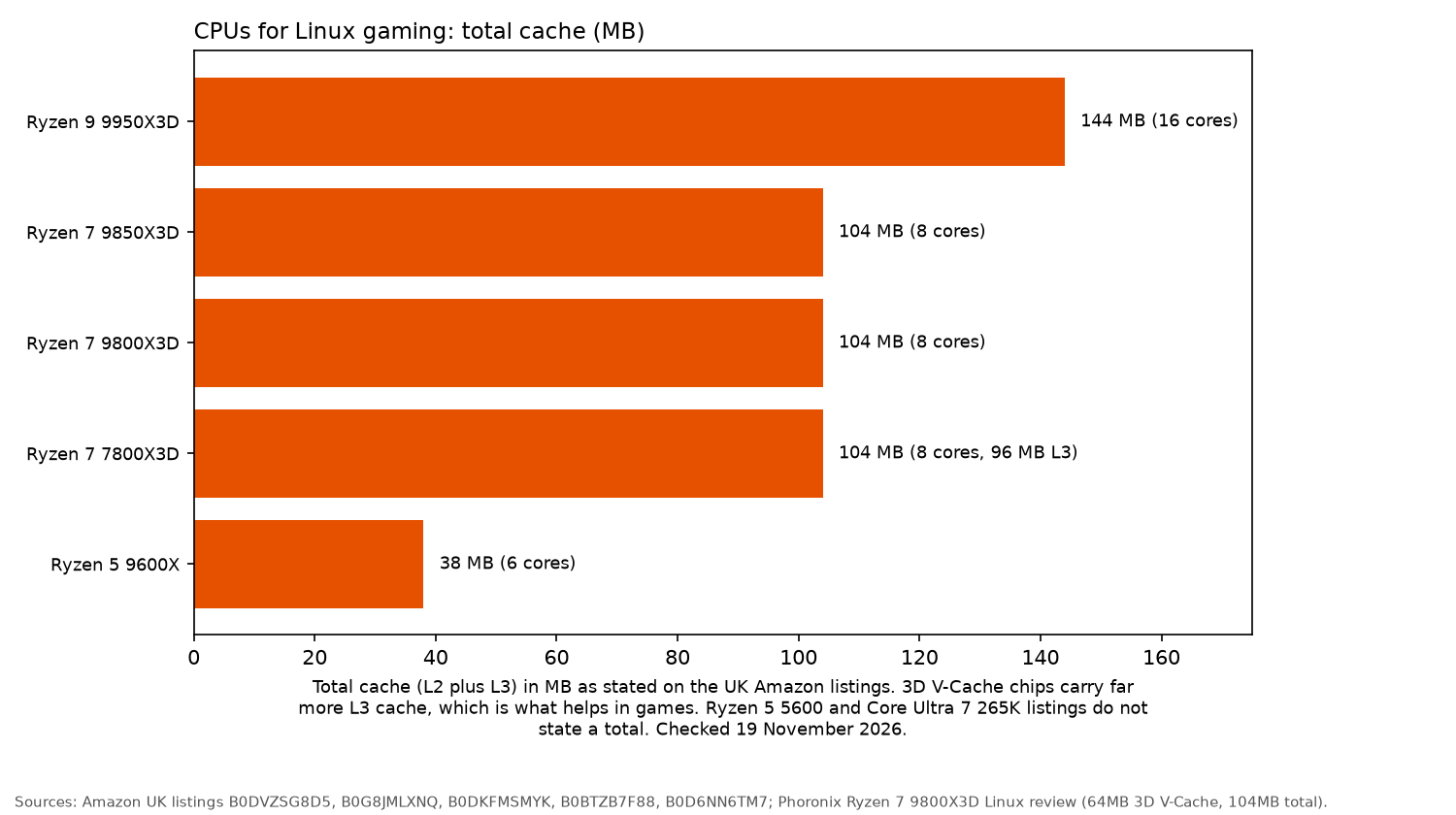
Chart caption: The bars match the image and the spec table: Ryzen 9 9950X3D 144MB, Ryzen 7 9850X3D 104MB, Ryzen 7 9800X3D 104MB, Ryzen 7 7800X3D 104MB and Ryzen 5 9600X 38MB. Those headline cache figures are on the UK titles. The 9850X3D bullet calls 104MB the L2 plus L3 total. The 9600X title says 38MB of cache, and a bullet on that listing calls the same 38MB an L3 cache. The Ryzen 5 5600 and Core Ultra 7 265K listings do not state one total, so they are not on the chart. The 64MB of 3D V-Cache inside the 9800X3D's 104MB is from Phoronix. Checked 19 November 2026.
Spec table
| CPU | Cores / threads | Boost clock | Total cache | TDP | Socket |
|---|---|---|---|---|---|
| Ryzen 7 9800X3D | 8 / 16 | 5.2 GHz | 104MB | 120 W | AM5 |
| Ryzen 7 9850X3D | 8 / 16 | 5.6 GHz | 104MB | 120 W | AM5 |
| Ryzen 7 7800X3D | 8 / 16 | 5.0 GHz | 104MB | 120 W | AM5 |
| Ryzen 5 9600X | 6 / 12 | 5.4 GHz | 38MB | 65 W | AM5 |
| Ryzen 5 5600 | 6 / 12 | 4.4 GHz | Not on listing | 65 W | AM4 |
| Ryzen 9 9950X3D | 16 / 32 | 5.7 GHz | 144MB | 170 W | AM5 |
| Core Ultra 7 265K | 20 (8P + 12E) | 5.5 GHz | Not on listing | 125 W base | LGA1851 |
Figures are from UK listings and Phoronix, checked on 19 November 2026. The 9800X3D 120 W figure is Phoronix's default TDP. That listing's wattage field says 140 watts. The 9850X3D bullet says 120 W, and its wattage field says 140 watts. The 9950X3D title says 170 W, and a description line says 120 W. The 9850X3D bullet, the 7800X3D title and the 9600X title say no cooler is included. The 5600 title includes a Wraith Stealth cooler. Where a listing disagrees with itself, the section below says so.
AMD Ryzen 7 9800X3D: best overall
The Ryzen 7 9800X3D strikes the best balance for most Linux gaming builds on AM5.
The UK title gives eight cores and 16 threads, 104MB of cache and up to 5.2 GHz. According to Phoronix, it has a 4.7 GHz base clock and a 5.2 GHz boost. Total cache is 104MB, including 64MB of 3D V-Cache, with a 120 W default TDP. The listing's wattage field says 140 watts. Those figures disagree. Check the product page before buying.
Phoronix found it "working without issue" on Ubuntu 24.04 LTS. All eight cores have access to the 64MB 3D V-Cache, so gaming performance does not rely on the Linux scheduler choosing particular cores.
Who it's for: most Linux gamers building on AM5.
Who it isn't for: heavy multi-threaded work, where 12 and 16-core chips pull ahead.
Check price on AmazonAMD Ryzen 7 9850X3D: fastest for gaming
The Ryzen 7 9850X3D uses the same design as the 9800X3D but raises the boost clock to 5.6 GHz, an increase of 400 MHz. Phoronix gives both chips a 4.7 GHz base and a 120 W default TDP. The UK bullet says the same 120 W TDP, 104MB of cache (L2 plus L3), an AM5 socket and no cooler. The wattage field on that listing says 140 watts, and the cooling method field says water. Those lines disagree with the bullet. Check the product page before buying.
In Phoronix's Linux tests, it was "2.6% faster overall" than the 9800X3D. Where the differences were significant, gains were commonly between 3 and 7%. It also drew around 4 W more power.
With an RTX 5090 running Cyberpunk 2077 through Steam Play, Phoronix found it delivered the best result among the chips tested.
The improvement is real, but modest. Notebookcheck says the leads over the 9800X3D do "not warrant an upgrade".
Check price on AmazonAMD Ryzen 7 7800X3D: best value X3D
The Ryzen 7 7800X3D remains a strong choice for high frame rates without paying for the latest X3D chip.
Its title gives eight cores and 16 threads, 120 W, an AM5 socket, 104MB of cache, up to 5.0 GHz and no cooler. A bullet gives a 4.2 GHz base, a boost up to 5.0 GHz, 8MB of L2 cache and 96MB of L3 cache, with DDR5 support.
Notebookcheck says the 7800X3D can deliver "nearly the same gaming performance" as the 9850X3D for less outlay.
Who it's for: high frame rates on AM5 for less outlay.
Who it isn't for: anyone who also compiles or encodes a lot.
Check price on AmazonAMD Ryzen 5 9600X: budget AM5
The Ryzen 5 9600X is the budget choice for an AM5 gaming build, with room to upgrade later.
The title gives six cores and 12 threads, a 65 W TDP, 38MB of cache, a 5.4 GHz max boost and no cooler. A bullet gives a 3.9 GHz base and a 5.4 GHz boost, and it names EXPO and PCIe 5.0. The description calls the architecture Zen 5. One bullet starts with Zen 5 and then says Zen 4. Those lines disagree. The same bullet calls the 38MB an L3 cache, while the title only says 38MB of cache. The cooling method field says air-cooled, while the title says no cooler is included. Check the product page before buying.
Phoronix included the 9600X in its 9850X3D test line-up. Choosing it also keeps the option of moving to an X3D processor later without replacing the motherboard.
Check price on AmazonAMD Ryzen 5 5600: AM4 upgrade
For a PC already running AM4, the Ryzen 5 5600 offers the cheapest route to a usable 1080p gaming CPU in this guide.
The title gives six cores and 12 threads, a 65 W TDP, an AM4 socket, a 4.4 GHz max boost and a Wraith Stealth cooler. A bullet names 400 and 500 series AM4 motherboards, and it lists a thermal cooling solution in the box. The listing's cache fields do not state one total, so this chip is not on the chart.
It runs with DDR4, which makes it a practical option for an existing AM4 system. The RAM guide pairs AM4 with a 32GB DDR4-3200 kit.
Check price on AmazonAMD Ryzen 9 9950X3D: gaming plus heavy work
The title gives 16 cores and 32 threads, 144MB of cache, 170 W and up to 5.7 GHz, on AM5, with DDR5 and PCIe 5.0. A description line on the same listing says 120 W and no cooler. Those lines disagree. Check the product page before buying. Notebookcheck points out that, unlike the 9850X3D, the 9950X3D has 3D V-Cache on only one of its two core chiplets, so the operating system has to place games on the right cores. See the Linux notes below.
Check price on AmazonIntel Core Ultra 7 265K: Intel option
The title gives 20 cores (8 performance and 12 efficient) and up to 5.5 GHz. The processor speed field says 5.4 GHz. Those lines disagree. The listing also gives 125 W processor base power, DDR5 and PCIe 5.0, for Intel 800 series boards. It does not state one total cache figure, so it is not on the chart. In Phoronix's Cyberpunk 2077 Steam Play test, the entire Ryzen 9000 line-up finished ahead of the Core Ultra 9 285K, so pick Intel for multi-threaded work or an existing platform, not for top frame rates.
Check price on AmazonLinux kernel and scheduling notes
- Kernel: Phoronix notes that Linux 6.12 or newer is needed for Zen 5 CPU power reporting. Any current distribution is otherwise in good shape for Ryzen 9000.
- Dual-chiplet X3D: Phoronix's Ryzen 9 9900X3D review says Linux 6.13 or newer also brings the 3D V-Cache Optimizer driver. That review covers the 12-core 9900X3D alongside the 16-core 9950X3D.
- Who else runs AMD: Valve's Steam Hardware Survey for October 2026, on the Linux view, lists AuthenticAMD at 66.25% and GenuineIntel at 33.03%.
- Proton: Both AMD and Intel CPUs can run Windows games through Steam Play (Proton). Phoronix used this method for the Cyberpunk 2077 results above.
- BIOS first: Phoronix says the 9800X3D works with existing AM5 motherboards "with a simple BIOS update". Update the motherboard before changing the processor, and check the manufacturer's CPU support list.
For storage, see the Linux gaming SSD guide to finish the build.
FAQ
Is AMD or Intel better for Linux gaming?
AMD has the edge in the current results. In Phoronix's Cyberpunk 2077 tests under Steam Play, the entire Ryzen 9000 line-up finished ahead of Intel's Core Ultra 9 285K.
Is the 9850X3D worth it over the 9800X3D?
Only for a new build if the gap is small. Phoronix measured an overall gain of 2.6%, while Notebookcheck says the leads do not warrant an upgrade from an existing 9800X3D.
Does 3D V-Cache help on Linux?
Yes. The 9850X3D led Phoronix's Linux graphics and gaming benchmarks. Phoronix's Ryzen 9 9900X3D review also notes the 3D V-Cache Optimizer driver in Linux 6.13 and newer.
How many cores do I need for Linux gaming?
In our view, six cores is a sensible minimum, while eight cores with 3D V-Cache offer the best balance for gaming. Phoronix points towards 12 and 16-core processors for heavier multi-threaded tasks such as compiling and encoding.
What kernel do I need for a Ryzen 9000 CPU?
Phoronix's 9850X3D tests used Linux 6.17 on Ubuntu 25.10. The 9800X3D review says Linux 6.12 or newer adds Zen 5 CPU power reporting.
More from OpenFrag: Gear · How we review